Can Digital Health Make Hypertension Management Easier for Nigeria?

Nr. Gabriel Aluu
Head of Nursing Administration
5 min read

Oct 28, 2026

0 Comments
2
0
Only 12% of Nigerians with hypertension have it under control. See how digital health can close the gap in screening, adherence and follow-up.
Think of one person you know who has high blood pressure. Maybe an uncle who says he feels fine, a mother who stopped her tablets when the headaches went away, or a neighbour who hasn't had a reading in years. Most of us know someone like this.
Hypertension rarely announces itself. Most people with high blood pressure feel nothing until a stroke, heart attack or kidney failure arrives. In Nigeria, the gap between people who have it and people whose blood pressure is controlled is one of the most serious health system challenges we face. Digital health can help close that gap, but only if it is built around the realities of Nigerian care.
The scale of the problem
One of the most comprehensive national surveys to date, the Removing the Mask on Hypertension (REMAH) study, examined 4,192 adult Nigerians across all six geopolitical zones (data collected March 2017 to February 2018) and found an age-standardized hypertension prevalence of 38.1%. Rates varied widely by region, from 20.9% in the North-Central to 52.8% in the South-East. Hypertension was as common in rural areas as in urban ones.
The larger problem is what happens after detection. Roughly 60% of hypertensive adults knew their status, about one-third were on treatment, and only 12% had their blood pressure under control. The study's care cascade shows where people are lost: 14.2% of hypertensive adults had never been screened, about 35% of those screened remained undiagnosed, and among the treated, 65.4% still had uncontrolled blood pressure.
This is not only a Nigerian problem. WHO 2025 report estimates that 1.4 billion adults aged 30–79 had hypertension in 2024, and only about 23% had it under control.
Where digital tools can help
Each breakpoint in that cascade is one that digital tools are designed to address.
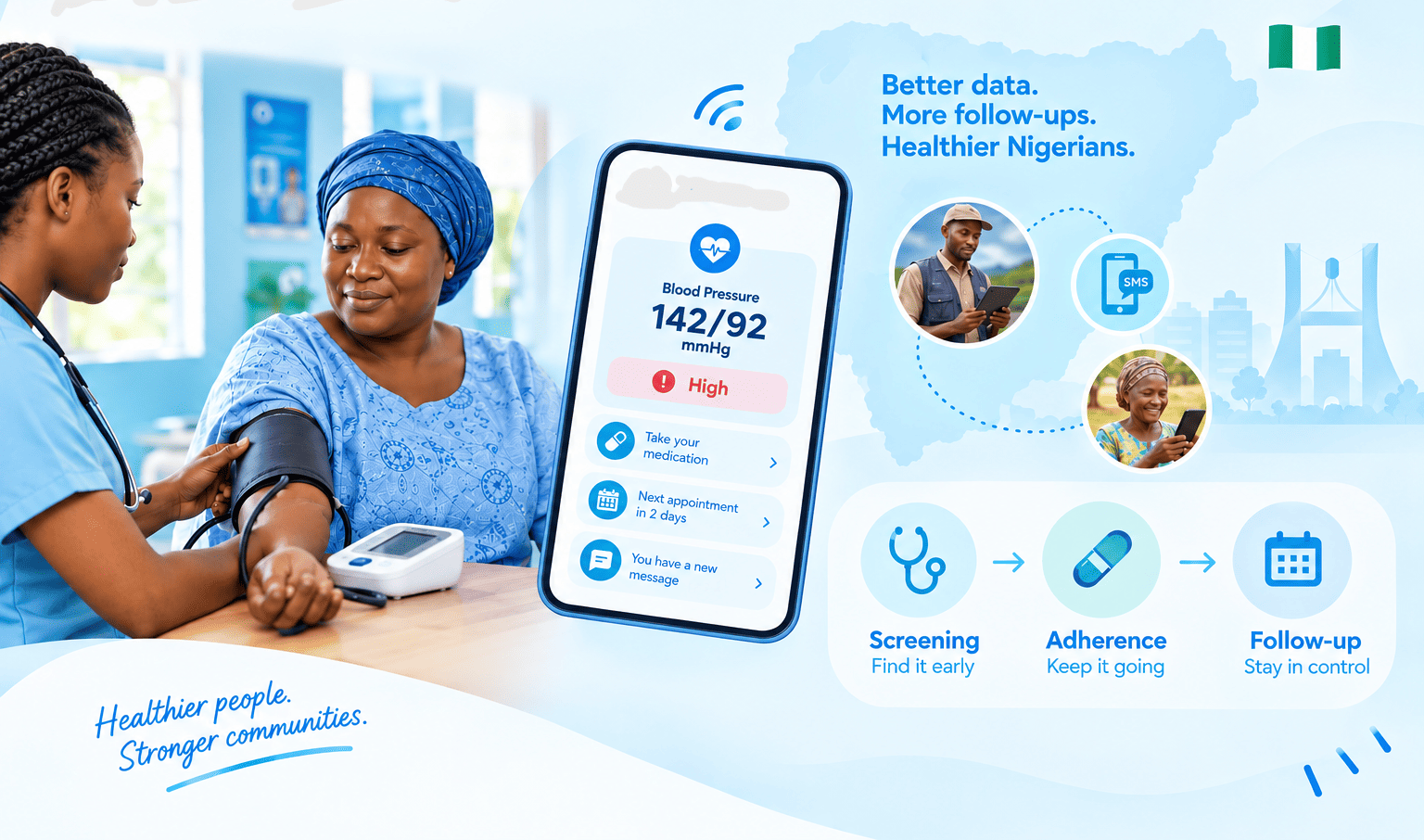
- Screening and early detection: Validated home or community blood pressure devices, paired with simple data capture, let community health workers, pharmacists and nurses record readings and flag high values for follow-up. The REMAH authors themselves suggested that volunteers trained to use semi-automated validated monitors could gather hypertension data.
- Adherence: Missed medication is a major reason treated patients stay uncontrolled. A 2025 randomized trial at University College Hospital, Ibadan, tested a 12-week two-way SMS reminder program among 150 patients with hypertension and/or diabetes. The authors note that adherence rates below 50% are widespread among Nigerians with chronic illnesses. A wider systematic review has examined randomized trials of text-messaging interventions for blood pressure control. SMS is a low-cost tool that works on basic phones.
- Follow-up and continuity: Appointment reminders, refill alerts and teleconsultations can keep patients engaged between clinic visits, which matters when many people only seek care once symptoms appear.
The limits we must be honest about
Technology alone will not fix hypertension care, for three reasons.
- Connectivity is uneven: GSMA estimates that about 140 million Nigerians were in the mobile internet usage gap in 2025, meaning they live in covered areas but do not use mobile internet. Solutions must work over SMS, voice or USSD, not only smartphone apps.
- Drugs and systems must be in place: A readiness assessment of primary health centres in the Federal Capital Territory found feasibility based on workforce and equipment, but there is a critical need for strengthening essential medicine supply, health-worker training, and treatment protocols. A mobile app that detects high blood pressure is of little use if the clinic has no drugs.
- Digital must sit inside a proven programme: WHO reports that Bangladesh raised hypertension control from 15% to 56% in some regions between 2019 and 2025 by embedding treatment services in its essential health service package and strengthening screening and follow-up. The lesson is that technology works best when it supports a structured care pathway.
The policy moment
The direction of travel is encouraging. The Federal Ministry of Health notes that the Nigeria Digital-in-Health Initiative was approved by the National Council on Health in November 2024, and the National Digital Health Architecture was endorsed by all states and the FCT in June 2025. That architecture aims to link systems through a national health client registry tied to the National Identification Number, health worker and facility registries, and a health information exchange platform. A proposed Digital Health Services Bill 2025 would introduce mandatory licensing for digital health service providers; it is a bill, not settled law.
For hypertension, interoperability matters most. If a patient's readings, prescriptions and follow-up history can travel with them across facilities and insurers, continuity of care becomes possible and easy.
What a practical approach looks like
- Use SMS and voice first; add apps for those who can use them.
- Train nurses and community health workers to lead digital follow-up, since they are already closest to patients.
- Link digital records to insurance and claims systems so that ongoing control of blood pressure is financed, not just one-off visits.
- Measure what counts: the proportion of patients whose blood pressure is controlled, not the number of app downloads.
Conclusion
Can digital health make hypertension management easier for Nigeria? Yes, at the specific points where patients are currently lost: screening, adherence and follow-up. But it will make care easier only when medicines are available, health workers are trained, and data flows through a coordinated system. The task is to build digital tools into the care pathway, from bedside to boardroom.
Don't wait for symptoms. Get your blood pressure checked at a nearby pharmacy, primary health centre or other health facility, and encourage one person close to you to do the same this week.
Visit MedixDeck for more evidence-based health information.
Stay informed on health trends
Join over 1,000 Nigerians receiving weekly verified medical insights directly from Nr. Gabriel Aluu and our team of experts.